The original objective can disappear
Derek could no longer win the semi-final once the injury occurred. Resilience therefore required accepting that reality rather than pretending the original outcome was still available.

World Champion | British Record Breaker | Olympian | Business Performance Coach | Motivational Speaker
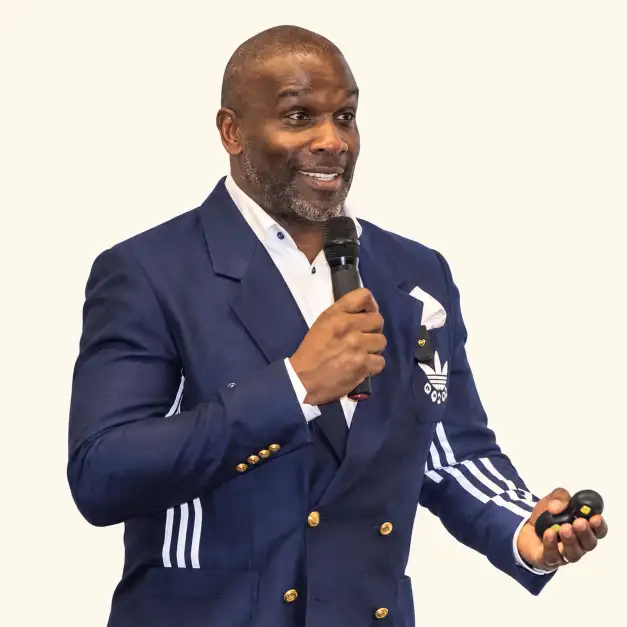
Dr Derek Redmond OLY is a former world-class British 400m sprinter, World and European 4×400m relay champion, former British record holder and internationally recognised motivational speaker.
His career contains both sides of elite performance: the exhilaration of becoming a World Champion and the reality of injury ending an Olympic dream in front of a global audience. What followed was not simply recovery. Derek repeatedly rebuilt his identity across sport, business, media, leadership and performance coaching.
Derek Anthony Redmond was born on 3 September 1965 in Bletchley, Buckinghamshire. Public biographies record his education at Roade School in Northamptonshire, with his later academic journey also including Nene College.
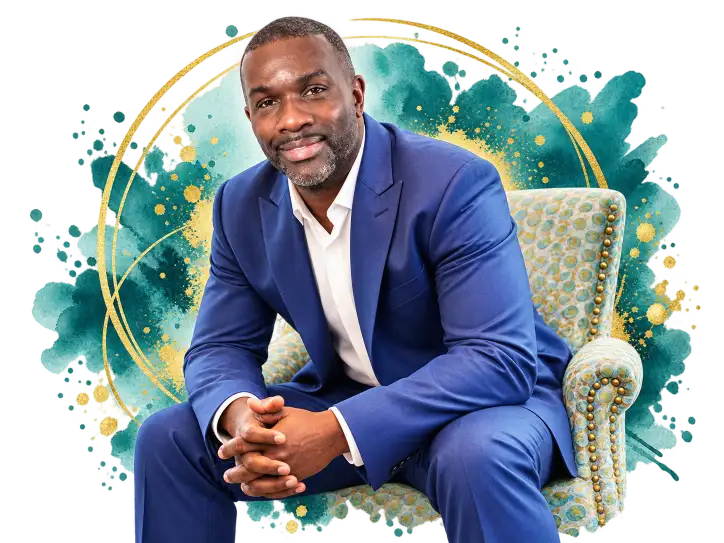
Redmond developed into one of Britain's outstanding quarter-milers during a period rich with 400m talent. His event demanded a rare balance: raw sprint speed, tactical judgement, speed endurance and the ability to maintain technique while the body is under extreme fatigue.
By his early twenties he was competing at national and international level. Public athletics records associate him with Birchfield Harriers, one of Britain's historic athletics clubs.
His rise was not defined by one breakthrough alone. The years that followed brought national titles, British records, major championship medals and repeated battles with injury.
Long before Barcelona made resilience the word most associated with Derek Redmond, his career had already required it. Elite sprinting repeatedly forced him to recover, rebuild and return.
Derek's breakthrough into the highest level of British athletics became unmistakable in 1985 when he ran 44.82 seconds for 400 metres, breaking the British record.
The record was subsequently surpassed by Roger Black, but Redmond responded by reclaiming it. At the 1987 World Championships in Rome he ran 44.50 seconds — a mark that remains his official personal best.
In Stuttgart in 1986, Great Britain's 4×400m team won the European Championship. Derek ran in the victorious final alongside Kriss Akabusi, Brian Whittle and Roger Black.
A year later, Great Britain secured silver in the 4×400m relay at the 1987 World Championships in Rome. The combination of individual speed and relay experience was establishing Derek as an important member of one of Britain's strongest generations of 400m runners.
Derek was selected for the 1988 Seoul Olympic Games, but an Achilles tendon injury prevented him from starting his opening 400m race.
Olympic records therefore list him as a non-starter rather than as having competed in the race itself. Derek later recalled how difficult that experience was: years of preparation had brought him to an Olympic stadium, only for injury to take away the opportunity before the competition properly began.
It became one of several serious interruptions during his athletics career. By the time he reached Barcelona four years later, he had already undergone numerous operations in the attempt to remain competitive.
Seoul matters because it changes how the Barcelona story should be understood. Barcelona was not the first time injury had taken something important from Derek. It was the second Olympic cycle in which his body would challenge the future he had spent years preparing for.
The ability to return after Seoul, regain form and arrive in Barcelona with genuine competitive ambitions is itself a major part of his high-performance story.
Derek's most important championship victory came before Barcelona. It was a lesson in strategy, trust and collective performance.
At the 1991 World Championships in Tokyo, the United States entered the men's 4×400m relay final as the established force. Great Britain chose not simply to follow the expected race pattern.
The British quartet changed its running order. Roger Black moved to the opening leg, Derek Redmond ran second, John Regis third and 400m hurdler Kriss Akabusi anchored.
The strategy was designed to place pressure on the Americans immediately rather than wait for the traditional final-leg showdown.
Britain won in 2:57.53, beating the United States by just four hundredths of a second. The result gave Derek Redmond, Roger Black, John Regis and Kriss Akabusi the World Championship title.
For organisations, the race provides a very different Derek Redmond lesson from Barcelona: success sometimes requires challenging convention, trusting colleagues, accepting personal role changes and committing to a collective strategy.
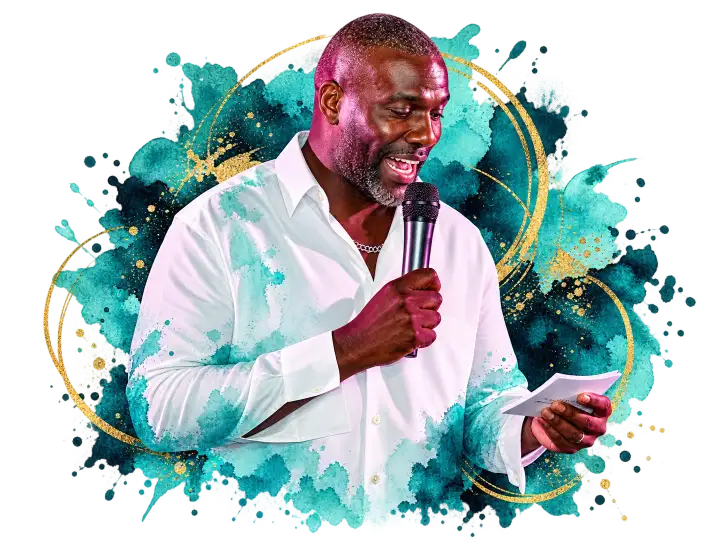
One of sport's most recognised images came from a race Derek Redmond did not officially finish.
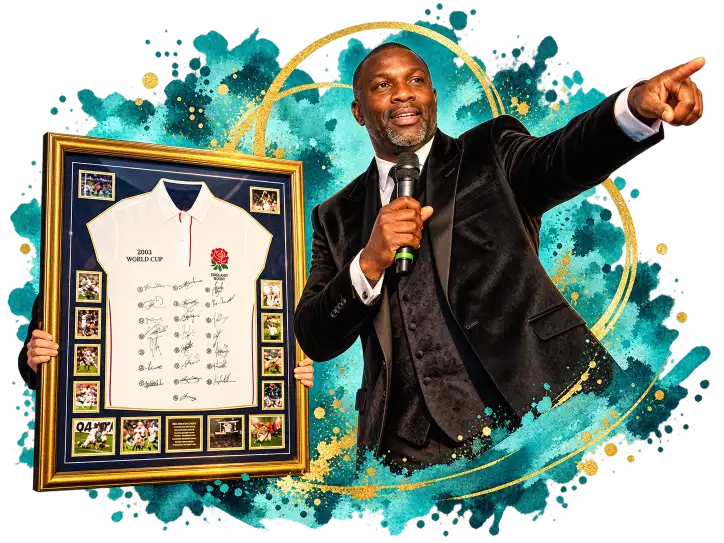
Derek's Barcelona campaign began strongly. He recorded the fastest time of the opening round and then won his quarter-final, advancing to the 400m semi-final with a realistic opportunity to reach the Olympic final.
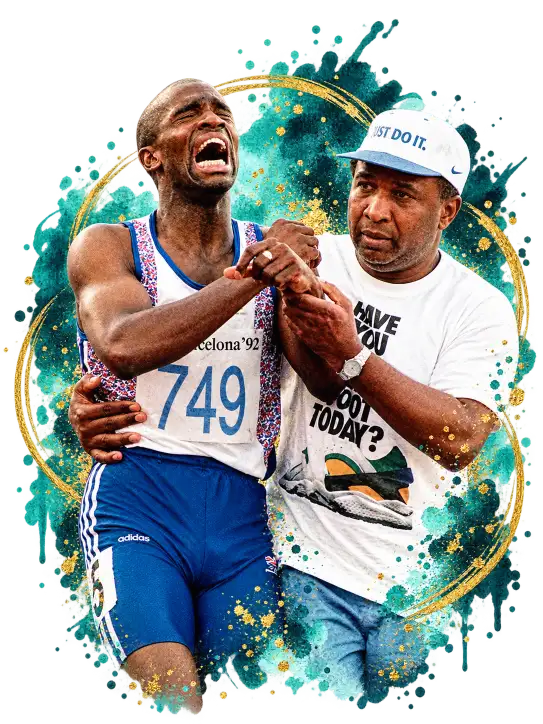
During the semi-final, his hamstring tore on the back straight. His race instantly changed from competing for an Olympic final to trying to process another devastating injury.
Instead of remaining on the track or accepting the stretcher that approached him, Derek got back to his feet and began moving towards the finish.
Derek's father, Jim Redmond, came down from the stands and made his way past officials to reach his son. After initially trying to persuade Derek that he had nothing left to prove, Jim supported him as the pair continued towards the line together.
They physically crossed the finish line, but because Derek had received outside assistance his official Olympic result is recorded as DNF — did not finish.
The lasting power of Barcelona is not that everything worked out. It is that the goal changed in seconds, and Derek still chose how he would respond.
Derek could no longer win the semi-final once the injury occurred. Resilience therefore required accepting that reality rather than pretending the original outcome was still available.
Events can remove options, but they do not necessarily remove every choice. That distinction is central to how Derek translates his Olympic story into business and leadership.
Barcelona became a story about father and son as much as athlete and injury. It remains a reminder that high performance does not mean doing everything alone.
Resilience does not require pretending a setback is painless. Derek crossed the line visibly devastated. The lesson lies in response, not emotional denial.
The Barcelona footage went far beyond athletics. It appeared in Olympic storytelling and advertising campaigns and became widely associated with perseverance, family support and the human side of elite competition.
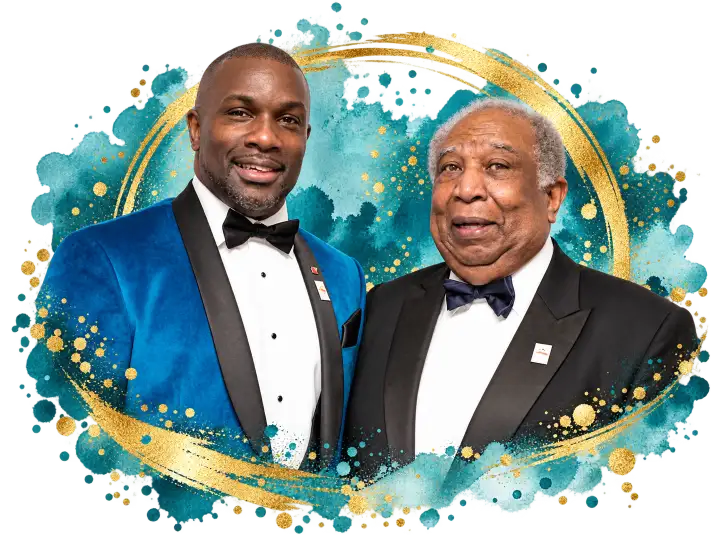
Twenty years later, Jim Redmond was selected as a torchbearer during the London 2012 Olympic torch relay — a symbolic return to the Olympic movement for the father who had stepped onto the Barcelona track in 1992.
Jim died in October 2022 at the age of 81. Tributes from the British Olympic community and International Olympic Committee returned to that moment in Barcelona and the impact the pair had created together.
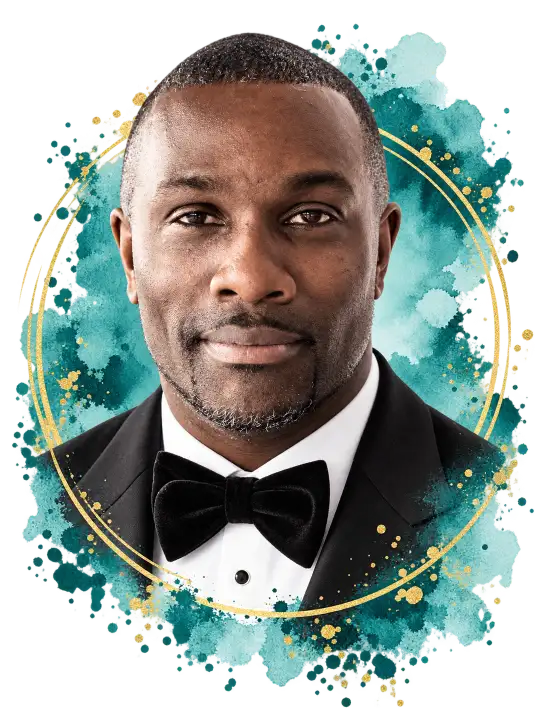
The injury in Barcelona effectively ended Derek's elite sprinting career. After further operations and attempts to return, he had to confront the loss of the identity around which much of his life had been built.
Instead of leaving competitive sport completely, he moved into new disciplines.
Derek played professional basketball for the Birmingham Bullets and represented England, proving that his sporting identity did not have to remain limited to the 400 metres.
His post-athletics sporting journey also included rugby sevens, adding another team environment with a very different physical and tactical demand.
Derek's official career history records further competition in kickboxing, including a British Kung Fu Association national championship result in 2013. His current biography also records later semi-professional boxing.
After learning to ride a motorcycle in 2006, Derek moved into endurance motorcycle racing. His official biography records the creation of Derek Redmond Racing and involvement with other racing teams.
Derek later served as Director of Development for Sprint and Hurdles at UK Athletics, moving from athlete to someone involved in developing other performers.
He became Group Performance Director at Thomas International, applying high-performance thinking in a business and behavioural-assessment environment.
His media work has included sports commentary for Eurosport, television appearances, event presentation and participation in programmes including Celebrity Gladiators, which he won in 1994.
He later served as an official timekeeper on Gladiators and has continued to appear across television and media projects, including Channel 4's The Greatest Auction.
In 2018 Derek published Sport Is A Business and Business Is A Sport, bringing together lessons about competition, teamwork, accountability and performance across the two environments.
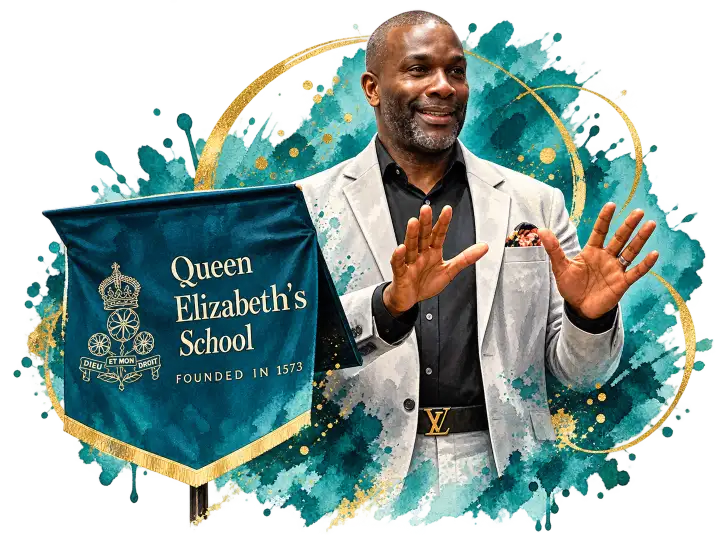
Derek has built a professional speaking career spanning more than three decades.
Barcelona gives Derek an immediately recognisable story, but his corporate work extends far beyond retelling that race.
His World Championship relay experience creates material around teamwork and strategy. His repeated injuries create lessons about uncertainty and changing plans. His post-athletics reinventions create a practical discussion about identity, career transitions and adapting when the original route disappears.
Derek's official and agency biographies record more than 1,000 professional motivational and keynote appearances, with his 1,000th keynote delivered in 2025.
Public speaker profiles record engagements across more than 50 countries and audiences ranging from leadership teams to major international events.
His client history includes organisations across finance, technology, engineering, healthcare, retail, professional services and sport.
Derek's current speaking material uses P.R.I.D.E. as a framework for team performance:
His B.R.A.V.E. leadership framework focuses on behaviour when teams and leaders face difficult decisions:
One of the most useful themes within Derek's story is that a changed route does not always mean the destination or purpose has disappeared.
It is a practical way of discussing change without pretending every original plan can still be achieved exactly as designed.
How to respond constructively when reality changes faster than the plan.
Preparation, standards, focus and the behaviours required when performance is visible and pressure is high.
What the 1991 World Championship relay reveals about trust, role clarity, strategy and collective responsibility.
Recalculating when the route changes while keeping people connected to purpose and direction.
Bold decisions, respectful challenge, authentic conversations, clear vision and empowering people to perform.
Understanding the difference between commitment to an outcome and rigidity about how that outcome must be reached.
Taking responsibility for preparation, behaviour and response rather than focusing only on circumstances outside your control.
Derek's current speaking portfolio also explores diversity, unconscious bias, inclusion and how different perspectives contribute to high-performing teams.
Rebuilding identity and performance after a career, role or opportunity ends unexpectedly.
In January 2026 Derek was appointed Regional Director of SportsAid Eastern, supporting the organisation's regional network, partners, sponsors and the development of talented young athletes.
He continues to deliver keynote speeches on resilience, teamwork, leadership, change, preparation, goal setting and sustainable high performance.
Derek's current official biography states that he works as a Business Performance Coach to a Formula One team, supporting engineers and technical specialists around mindset, collaboration and performance.
Derek serves as an ambassador for Air Ambulances UK, helping support awareness of the work of air ambulance charities.
Alongside speaking and event hosting, Derek works as an auctioneer. His official biography and SportsAid Eastern profile report that his auctioneering has helped raise more than £1.8 million for charitable causes.
His current biography also records continued competitive involvement in basketball through Great Britain's Over-55 men's programme — another example of a sporting career that did not stop when elite athletics ended.
At the 2026 LUPC & SUPC Conference, Derek was scheduled to close the conference with a session focused on building resilience and sustaining high performance through change.
The conference programme framed his session around practical approaches to uncertainty, organisational resilience and maintaining excellence while environments evolve.
In August 2026 Derek's official website highlighted a keynote for Streets Chartered Accountants, where his themes included resilience, teamwork, preparation, leadership, goal setting, business growth and responding constructively when plans change.
This current work demonstrates why his story remains relevant decades after Barcelona: the context has changed, but organisations still need people who can perform, collaborate and adapt under pressure.
Derek Anthony Redmond is born on 3 September in Bletchley, Buckinghamshire, England.
Derek is educated at Roade School in Northamptonshire before developing into a national-level athlete.
Runs 44.82 seconds to break the British 400m record.
Wins 4×400m European Championship gold for Great Britain in Stuttgart.
Reclaims the British 400m record with 44.50 and wins World Championship 4×400m silver in Rome.
Selected for Seoul but unable to start the 400m because of an Achilles injury.
Great Britain defeat the United States in Tokyo to win the 4×400m world title in 2:57.53.
After winning his quarter-final, Derek tears his hamstring in the Olympic semi-final and continues towards the finish with his father Jim.
Wins Celebrity Gladiators and becomes part of a growing post-athletics media career.
Competes across basketball, rugby sevens, combat sport and motorcycle endurance racing.
Serves as Director of Development for Sprint and Hurdles at UK Athletics.
Learns to ride and moves into motorcycle endurance competition and racing-team projects.
Jim Redmond carries the Olympic torch during the London 2012 relay.
Derek's official achievements history records victory at the British Kung Fu Association National Championships.
His official achievements page dates his appointment as Group Performance Director at Thomas International to this period.
Receives the International Fair Play Mecenate Award in Italy and becomes an ambassador for Right To Play.
Publishes Sport Is A Business and Business Is A Sport.
Derek's father Jim dies aged 81; tributes revisit the pair's unforgettable Barcelona moment.
Appears as an auctioneer on Channel 4's The Greatest Auction and continues commercial ambassador work.
Becomes an ambassador for Air Ambulances UK and continues his international speaking and sporting commitments.
Reaches his 1,000th professional keynote milestone and receives an honorary doctorate.
Appointed Regional Director of SportsAid Eastern while continuing corporate speaking, coaching, hosting and charity work.
Derek Redmond is a former British 400m sprinter, World and European 4×400m relay champion, former British record holder, Olympian, author, business performance coach and professional motivational speaker.
He is widely known for the 1992 Barcelona Olympic 400m semi-final in which he tore his hamstring, got back to his feet and continued towards the finish before being joined by his father Jim. His sporting career also includes a 1991 World Championship relay gold medal and two British 400m records.
Derek physically reached the finish line with his father, but Olympic results officially record him as DNF because he received outside assistance.
His official 400m personal best is 44.50 seconds, achieved in 1987. That performance reclaimed the British record.
Yes. Derek was part of Great Britain's men's 4×400m relay team that won the 1991 World Championships in Tokyo in 2:57.53.
Great Britain's final consisted of Roger Black on the first leg, Derek Redmond second, John Regis third and Kriss Akabusi on the anchor leg.
Derek was selected for the Seoul Olympic Games but an Achilles injury prevented him from starting his opening 400m race.
His post-athletics career included professional basketball, rugby sevens, combat sport and motorcycle endurance racing.
His current speaking themes include mental resilience, leadership, high performance, teamwork, change management, accountability, communication, goal setting, diversity and inclusion, motivation and overcoming adversity.
Yes. Derek has spent decades translating elite-performance lessons into corporate settings and has held senior business-performance roles. His current official biography also records work as a Business Performance Coach to a Formula One team.
In 2026 Derek is continuing his international corporate speaking and performance work and serves as Regional Director of SportsAid Eastern. He also works across event hosting, ambassador projects, charity auctioneering and performance coaching.
Contact The Immersion Project through the contact page or email sue@theimmersionproject.co.uk to discuss your audience, event objectives, format and availability.
Career information on this page has been cross-checked against official or authoritative athletics, Olympic, media and current professional sources.
Derek Redmond offers something broader than a famous Olympic story. He has experienced winning at world level, losing an Olympic opportunity publicly, rebuilding across multiple careers and spending decades helping organisations understand what performance looks like when plans change.
Explore more Sports & High-Performance speakers , discover Corporate Events , browse all speakers , or tell us what you want your audience to think, feel or do differently.